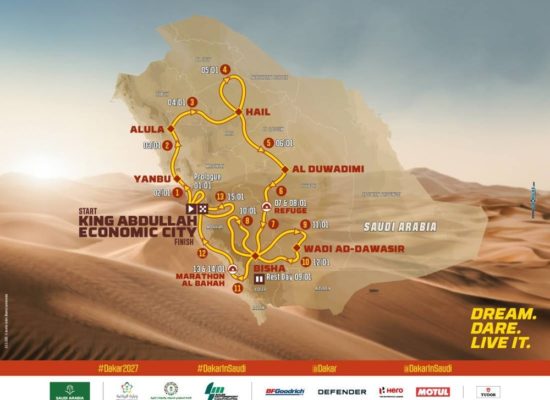
Who will be the fastest of them all? It’s a fitting thought when trying to predict how the 2026 Dakar Rally will unfold from the clues hidden in its route. The setting that greets competitors at the start — the Red Sea lapping against the shores beside the Yanbu bivouac — will be the same dramatic backdrop awaiting them two gruelling weeks later.
While not striving for perfect symmetry, the organisers have crafted a route that is both balanced and uncompromising. Fast tracks give way to sandy and rocky stretches, immense dune fields stretch endlessly to the horizon, and mammoth endurance-focused stages return to test the limits of every entrant. The essence of the Dakar remains unchanged for 2026, but the mixture has been subtly reworked, offering fresh challenges and new flavours.
Midway through the opening week, competitors will face a revised take on the marathon stage — a night spent in a stripped-back, refuge-style bivouac where assistance is limited strictly to what fellow competitors can offer (Stages 4 and 5). Mechanical discipline and physical resilience will be decisive. Stage 6, the longest of the rally at 925 km (336 km timed), will immerse the field in a vast expanse of sand and dunes before they reach the rest day in Riyadh.
After a brief respite in the Saudi capital, the return leg promises to be every bit as demanding. The rally resumes with the route toward Wadi Ad-Dawasir (Stage 7), last visited in 2022, followed by the second refuge-style marathon stage — this time with separate routes for FIM and FIA competitors. The pressure will intensify for title hopefuls and those simply fighting to reach the finish. By this point, some may believe the worst is behind them, yet over 1,700 km still remain, including 762 km of special stages. The notoriously complex navigation between Bisha and Al Henakiyah (Stage 11) is poised to reshape the rankings. As seasoned Dakar followers know, even a single grain of sand can decide the outcome. Celebration will have to wait until Yanbu comes back into view — presenting itself to competitors in a whole new light.
SAUDI NEXT GEN: ALL SYSTEMS GO FOR LAUNCH
The Saudi Next Gen programme took its first steps during the 2025 Dakar, guiding five young crews through an intensive “Rally Raid 101” curriculum and giving them the chance to earn a place in the 2026 edition. Two crews — Hamza Bakhashab with Raed Alassaf, and Abdullah Al Shegawi with Fahar Alamr — graduated from the inaugural academy and will take their positions at the start line of the SSV category in Yanbu.
A second intake, eager to follow the path forged by national hero Yazeed Al Rajhi, is preparing for five demanding days in Yanbu. These participants were selected from around 50 candidates representing a broad spectrum of motorsport disciplines.

MISSION 1000: MOTORBIKES RISING TO THE CHALLENGE
The third edition of the Mission 1000 Challenge will bring together seven fully electric motorbikes and a hybrid truck powered by hydrogen and biodiesel. Each day, they will assess their performance across routes of approximately 100 km.
Segway returns with upgraded, higher-performance batteries; Arctic Leopard machines — already in action in 2024 — come back with three Spanish riders from a private team; and the increasingly successful Stark Future bikes form the backbone of two new independent entries joining the Mission 1000 roster.
Meanwhile, the KH7 hybrid truck continues to emerge as a symbol of the programme, having achieved top results twice already.
As part of the wider Dakar Future initiative, the event continues to push forward the development and use of sustainable fuels, including next-generation biofuels.