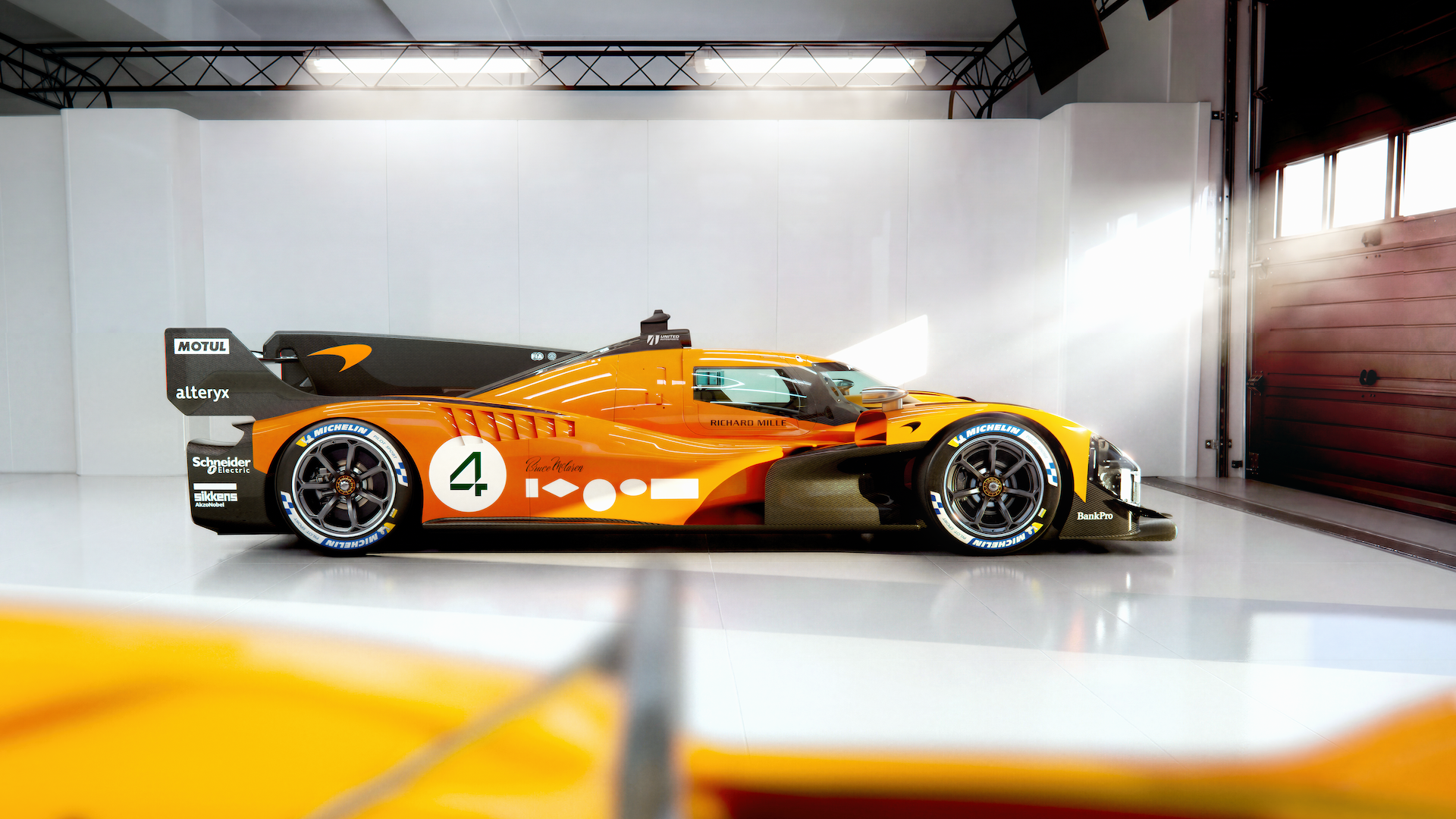
As McLaren prepares to enter Hypercar in 2027, completing the car is only part of the task. The more demanding challenge is building an organisation that can learn faster than the teams it intends to beat.
McLaren is approaching the point at which a development programme becomes a racing team.
The car is nearing its final specification. Two tests remain before the end of the year. The next, at Portimão later in November, is expected to bring all six drivers together, with the remaining European running helping determine how they will be divided between the two cars. Homologation is approaching, and the emphasis is moving from major technical decisions towards validation and refinement.
It is an important transition, but not necessarily the most difficult one. A car can be substantially complete while the organisation around it is still discovering how to extract its performance.
That distinction ran through team principal James Barcley’s account of McLaren’s preparations. There was confidence in the work completed, but considerably less enthusiasm for predicting what it would deliver against an established field.
The aim is to compete for podiums and victories. The uncertainty is how quickly the programme can convert its resources into the circuit knowledge, operational judgement and repeatable execution that its rivals have spent years developing.

“We have to run faster than our competitors. The way we talk about it as a team: if we run at the same pace, we’re not going to catch up. So we have the really hard challenge of running faster than our competitors to close that gap.” Barcley said at the World Endurance Championship final round at Monza.
“That’s the challenge we’ve come into. That’s always a challenge of new teams coming into World Championships. It’s not easy. That’s why you don’t see it all the time. You have to have time to prepare properly, and you have to expect year one is absolutely going to be a learning year. To expect anything different is dreaming.”
The important word here is not “faster” in its conventional racing sense. James is describing the speed of an organisation’s development.
McLaren does not simply need to improve. It needs to improve while its opponents are doing the same. Closing a gap requires a greater rate of progress, not merely evidence that the new programme is moving forward.
That makes its first season a more complicated proposition than a succession of finishing positions. Results will remain the public measure. Internally, the more useful questions may concern how quickly a problem is understood, whether a solution transfers between circuits, and whether the same operational weakness appears twice.
The team’s argument is not that those demands should excuse poor performance. It is that they explain why arriving with a competitive car and becoming a consistently competitive entrant are different achievements.
The journey to homologation
Barcley described the car as largely where it needs to be ahead of homologation. There is no fundamental aerodynamic or powertrain shift planned. The remaining development concerns fine detail, although software will continue to evolve after racing begins.
“We’re largely there, but we’ll continue developing everything right up until the last opportunity. To be really honest, it’s always a weigh-up that you don’t leave it so late. You can chase performance, but then you don’t chase reliability.
“There’s no fundamental shift in aero, in powertrain. It’s now really around fine-tuning, making sure we have the drivability we want. The software side of the car will continue to evolve and develop even once we start racing.
“Fundamentally, it’s been very positive so far in how the car is performing. But the key point is finishing the validation and using these last few weeks just to really fine-tune where we are.”
There is a management decision concealed inside that technical description. When does another possible improvement become less valuable than proving what is already fitted?
Barcley explicitly identifies the tension between pursuing performance and establishing reliability. Read alongside his account of the remaining programme, it suggests that the final tests are not simply opportunities to make the car quicker. They are opportunities to reduce uncertainty.
That matters because unresolved technical questions can complicate everything around them. If the team is still establishing the behaviour of a component, interpreting a driver’s feedback or comparing two setups becomes a less straightforward exercise.
A stable baseline does not guarantee a fast car. It does, however, give the team a clearer basis for understanding why the car is fast or slow.
McLaren’s decision to conduct its development with one chassis follows the same logic.
“We’ve run with the same development car all the way through. That was always our plan. We wanted to validate and finalise before we went straight into two cars.
“Before you go and commit to doing two cars, it’s better to concentrate your time on developing your parts, and then from there, once we’re clear and comfortable, we can go into manufacturing more parts.
“If you start later, you probably have to double up efforts to accelerate your learning with two cars running. If we started later, we might have had a different approach. But our approach was to start early with one car, validate the parts, and then finalise all the tooling.”
This is not evidence that one development car is inherently preferable to two. Barcley himself makes the choice conditional on the time available.
It points to fully compatible data. Running one car brings many advantages. The first is avoiding the multiplication of unfinished work. The second is total comparability of data. There are not going to be differences heralded by different chassis, no matter how precise they should be. The limitation is that the next phase must still establish how the wider operation functions when the focus expands beyond a single development platform.
The programme’s progress should therefore be understood in stages. Completing one car’s development does not, by itself, complete the preparation of a two-car racing team.
Putting the driver combinations together
The move towards a full driver group introduces another set of variables.
McLaren has a view of its likely combinations, but intends to use the remaining European tests to finalise them. Its assessment begins with performance, then moves towards the personalities and working relationships within each crew.
“The drivers have to have that ability to have that pace in the first place. So then we go from the baseline that everyone has that ability to be right at the front of the field, ” Barcley continued.
“Then it’s about the pairing of different characters. Every driver is different. Some are very calm, some can be great leaders within their group. Others are more fiery, and there are certain situations where you want to put some of those drivers into those close-racing scenarios.
“You want the drivers to have a bit of fire. You also want the drivers to have the calming effect within that group. If you have three lions, sometimes that can be very challenging as well.”
The “three lions” line is a great sound bite, but the more substantial point is that McLaren does not regard a crew as the sum of three individual rankings.
Once the required speed is established, selecting the combination becomes a question of how different strengths interact. The team wants competitive aggression without making aggression the only available response. It wants leadership, but also a group capable of learning and working together.
There is a useful distinction here between compatibility and similarity. Barcley is not arguing that the drivers should all behave alike. He is arguing for differences that serve the group.
That also makes the assessment more difficult than a straightforward comparison of lap times. A driver’s contribution may include how clearly they explain a problem, how they respond when another driver prefers a different solution, or how they help the group recover from a difficult session. Those are analytical questions raised by McLaren’s approach, rather than capabilities the press conference establishes for any particular individual.
The team’s preference for three drivers in each car throughout the season gives it more opportunities to develop those relationships.
“Coming into it, that is our default position, and we’ll adjust and take it from there. But if I think of some of our top competitors, they run three drivers, and I think it creates really good consistency as well.
“When the pressure’s on in that biggest race of the year, it’s a bit like getting a group of golfers together and saying some of you can practise for that long, and one of you can practise for a bit less, and expect that one to perform at the same.”
The golfing comparison makes clear that McLaren sees the wider season as preparation for Le Mans, not merely a series of separate events.
Its default approach distributes competitive experience across the full crew. In principle, that gives each driver more opportunities to become part of the team’s decision-making and feedback processes before the largest assignment arrives.
James did not present that position as irreversible. McLaren retains options. But the preference indicates what it currently values: continuity, shared preparation and fewer changes to the working group.
What a driver promotion tells us about the programme
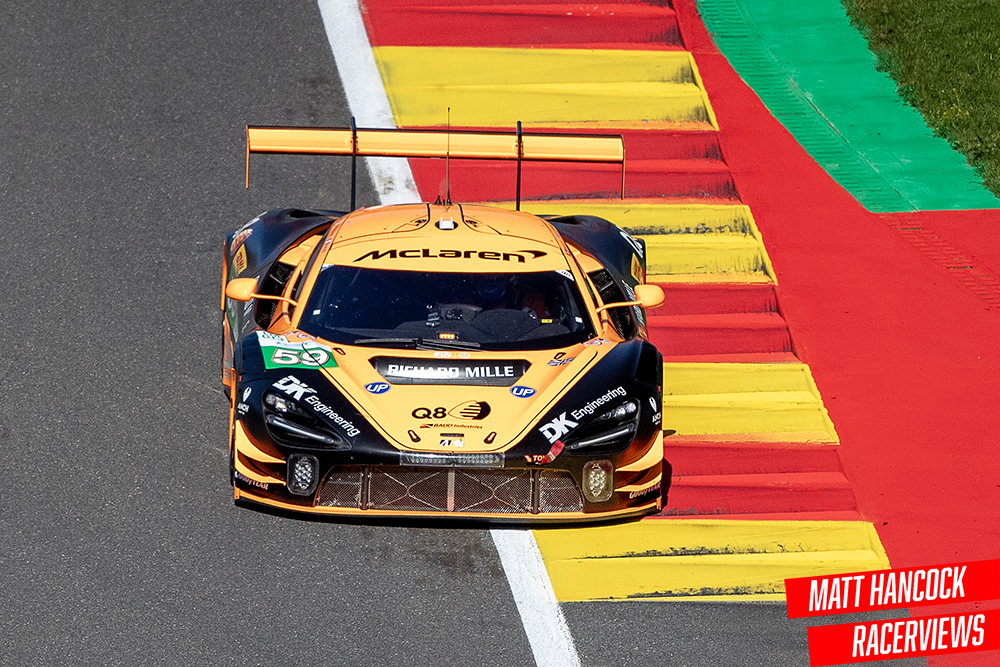
Grégoire Saucy’s elevation provides a more specific view of how McLaren is evaluating drivers.
His speed was part of the assessment, but James returned repeatedly to evidence from racing: traffic management, overtaking and performance on cold tyres. The test programme provided experienced reference points; LMP2 competition showed how he applied his ability in less controlled circumstances.
“From a pace point of view, we could see that Saucy absolutely had that capability. Then it was around seeing Saucy in our test programme, how he would compare against benchmarks.
“Seeing how Grégoire could learn from them, but also match them and work with them in terms of those race runs, those quali runs.
“Then in the ELMS this year, it’s been incredibly competitive at the front of the field, and to see Grégoire’s traffic management, how he’s been incredibly efficient and effective in getting past people … how he is on cold tyres, all those scenarios we’ve been able to assess from his LMP2 programme.”
There are two distinct tests in that explanation.
One concerns whether a driver can reach an established performance standard. The other concerns how effectively the driver uses that performance when the circumstances become variable.
McLaren appears to have sought evidence from both environments rather than treating development mileage as a complete assessment. A test can reveal pace and the quality of technical feedback. Racing adds decisions involving other cars, changing opportunities and consequences that cannot be reset for another run.
Saucy’s account also places the promotion within a broader development process. He described support with physical and mental preparation, working with engineers and teammates, and learning from experienced drivers during the Hypercar tests.
That offers a potentially richer way to frame McLaren’s driver development programme. Its value is not just whether it identifies talent, but whether it prepares that talent for the specific demands of the role available.
For the feature, the interesting question is therefore not simply whether McLaren has selected a promising young driver. It is whether the pathway has shortened the distance between being quick enough for Hypercar and being ready to contribute to a new Hypercar team.
What there is to learn for 2027
Barccley outlined what needs to be learnt, or caught up upon when coming into Hypercar. Notably, in process, circuit preparation and tyre management. Testing helps, but he did not present it as a complete substitute for repeated competitive experience.
“We haven’t been running a Hypercar at the races where there are World Endurance Championship events. In many cases, people have been back there five, six, seven times.
“From that perspective, we have a lot of catching up to do. That’s a big mountain that we have to climb. You can be close. The last bit is the really hard bit, and to refine your controls, your systems to be absolutely correct for the track.
“Tyre management … we don’t have tyre warmers in this championship. How you manage the tyre, especially on the out-lap, how you manage it over the stints, is a really, really critical factor.”
This is where the distinction between individual experience and collective experience becomes important.
McLaren can bring together people who understand endurance racing. That does not mean the resulting group already knows how its particular car, software, drivers and operating procedures will interact at every circuit.
James’s description points towards knowledge that is specific to the programme. It must be generated, interpreted and retained by the organisation itself.
Cold tyres make that challenge tangible. The issue is not only whether a driver can survive an out-lap without making a mistake. It is how quickly the car can become competitive, how the driver uses it during that transition, and what the team learns from the outcome. James identifies both activation and stint management as critical, linking a brief phase of the race to the longer performance picture
The analysis should not turn this into an argument that McLaren is destined to struggle. The press conference provides no basis for that prediction.
It does explain why a promising test programme cannot settle the question of competitiveness. Testing can demonstrate progress against the team’s own objectives. Racing will reveal whether those objectives were sufficient.

Strategy as an asset
“You can have all the pace in the world, but if you don’t run your race strategy in the right way, it could be very quickly eroded and lost.” Barcley continued.
“You have your powertrain group, your aero group, your software group, your simulation group, and your strategy group are a fundamental part of that.
“To have a group that can think outside the box, can develop the right tools and capabilities to give us hopefully an advantage over competitors … trying to have a fantastic strategy group that put you in a position to win races by making those calls, even if it’s sometimes seconds ahead of your competitors.”
We have seen that plenty of times in the 2026 FIA WEC, and we hear it more in F1. Ultimatly, however, priortising strategy has its roots in the Audi days, and it has become ever more important and sophisticated.
As such it comes to maximising the performance the car, and creating opportunities that the car alone might not provide.
Barcley singled out Toyota’s strategic calls during the season as examples of the opposition’s quality. His point was not that McLaren had discovered an overlooked route to success. It was that strategy is another area in which the existing teams have set a demanding standard.
That is another reason the programme cannot be reduced to the completion date of the car. The machinery and the decision-making structure must be ready together.
Entering in 2027, eyes already on 2030
Beyond the debut sits another deadline.
McLaren is preparing its current programme while contributing to discussions about the technical direction for 2030. Barcley supports evolution and the proposed direction towards a single technical ruleset, but repeatedly returns to commercial viability.
“We need to be careful we don’t go back down the route of the past, where it becomes so complex, so expensive that the business case just doesn’t stack up.
“It has to have the right ROI, it has to be the right budget, and it has to be the right makeup of technical contribution in the car. That’s also relevance versus cost.
“You can say it has to be the latest cutting edge of everything, and it has to be completely road relevant, or whatever it might be. But you have to fundamentally come down to it: can it be a viable business case for the teams and the manufacturers?”
His position is not simply an argument against technical ambition. It is an argument about the conditions under which that ambition remains sustainable for the organisations paying for it.
There is also a tension particular to McLaren’s timing. The team is still learning the current category while being asked to help shape its successor. James acknowledged that its understanding should deepen through participation, rather than suggesting that an incoming manufacturer already possesses all the answers.
That makes regulatory stability more than a convenient preference. Large changes require manufacturers to reassess development effort, cost, staffing and capability. As James noted, the publication of regulations starts that organisational homework; it does not finish it.
For McLaren, then, 2027 is both a competitive debut and the beginning of a more informed position within the category. It will learn how to race the car while also learning what it needs from the championship’s future.
Does the McLaren name bring raised expectations?
Asked whether McLaren could afford a humble approach, Barcley answered directly.
“Absolutely, because anything else is arrogant in this level of competition.
“Everything about our programme, the approach we’re taking with our investment in the programme, the driver lineup, the quality of the people we have across the team, is all about putting ourselves in a position, of course, to fight for podiums and win races.
“We’re not here just to compete. We’re here to compete to be successful. But we also realise that this is a World Championship, and part of the reason we’ve come is because of the level of competition.”
The apparent contradiction is the useful part. McLaren is investing with the intention of winning while declining to claim that its preparation guarantees victory.
That can be read as expectation management. It is also consistent with the substance of the programme James describes: validate before expanding, assess drivers in more than one setting, build continuity into the crews, and recognise the knowledge still to be acquired.
The more revealing test will come when the team has competitive evidence rather than development targets. If the car is quick, can the operation repeatedly use that speed? If it is not, can the team identify the cause without confusing technical limitations, circuit learning and execution?
McLaren’s name ensures that those questions will be asked loudly. Its first season will begin supplying the answers.
For now, the most credible expression of ambition is not a prediction of where the cars will finish. It is the acknowledgement that catching established opponents requires more than matching their effort. McLaren has to make its learning count faster.
The RacerViews info –
By Sam Tickell, on location at the FIA WEC 6 Hours of Monza
We are passionate, dedicated motorsport professionals.
In 2026 you will see us trackside and stageside with exclusive coverage of
- The World Endurance Championship
- The World Rally Championship
- Belgian Rally Championship
- British GT
- British Rallycross
- and more!
We aim to bring you interviews and photos you won’t see anywhere else. We don’t aim to break the news, rather we aim to bring the voices of the racers to you and the atmosphere of the event to you at home. Our social media presence on Facebook, Twitter and YouTube bring you more, a holistic experience. We partner with racers and professionals in the industry and give back where we can. If we can help you or you have a story to share, please contact us.