GTP – Cadillac breaks the drought
The headline in GTP was cathartic: Wayne Taylor Racing, winless in the top class for more than two years, finally broke its drought with the No. 10 Cadillac V‑Series.R of Ricky Taylor and Filipe Albuquerque in the Motul SportsCar Endurance Grand Prix at Road America. On a weekend when the race stretched to six hours for the first time, putting it in proper endurance company alongside Daytona and Sebring, their win felt like both a sporting result and a release valve for a team that has spent too long explaining near‑misses.
Taylor and Albuquerque’s victory came at the end of a chaotic, traffic‑heavy race that ran the full 6:00:45.052 over 4.048 miles and 14 turns, with prototypes carving their way through four classes and 54 cars. The No. 5 JDC‑Miller Motorsports Porsche 963 of Laurin Heinrich, Kaylen Frederick and Tijmen van der Helm finished just 1.960 seconds behind, underlining how thin the margin still is at the end of six hours around Elkhart Lake. WTR’s No. 40 Cadillac, driven by Jordan Taylor and Louis Delétraz, completed the overall podium, giving the team an emphatic 1–3 result on the day it finally returned to the top step.
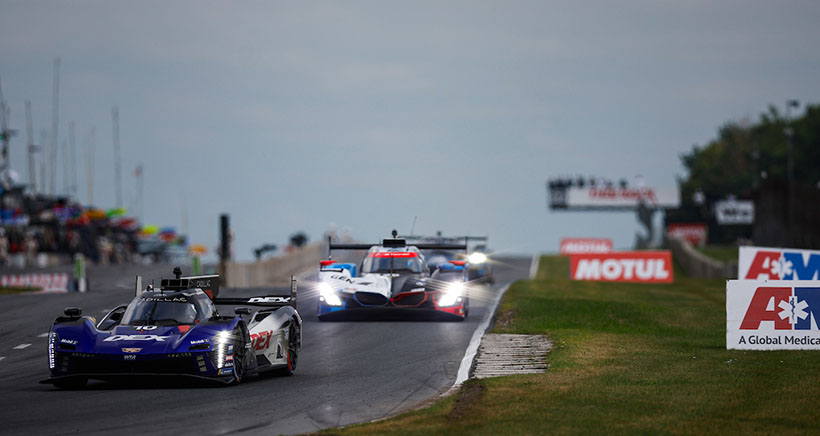
Further back, the factory Acura and Porsche entries had to absorb the realities of a longer format at Road America. Meyer Shank Racing’s No. 93 Acura ARX‑06 (Renger van der Zande, Nick Yelloly) and Porsche Penske Motorsport’s No. 7 963 (Felipe Nasr, Julien Andlauer) both spent long stretches dealing with traffic and strategy calls that looked fine in isolation but were exposed by the six‑hour accumulation. BMW M Team WRT’s hybrid, too, found itself a couple of laps down by the flag, part of a group reminding the paddock that Road America’s long, green‑flag runs and limited margin for error make this circuit as much a test of operational discipline as raw pace.
For the broader GTP picture, the win matters. The championship table has been anchored by other teams – Whelen Cadillac, Porsche Penske – but Road America showed that on a day when traffic, weather and full‑distance reliability all align, Wayne Taylor Racing can still impose itself on the class it helped define in the early years of DPi and GTP. It gives the team a foundation to build on in the remaining endurance rounds, and the series another reminder that the Cadillac camp, when it gets its processes right, still has the sharp end of the grid fully within reach.
LMP2 – Inter Europol’s quiet streak
LMP2 at Road America didn’t have the overall spotlight, but it did have a story that will matter in the archives: Inter Europol Competition’s No. 43 ORECA LMP2 07 scored its second consecutive win, continuing a run that is starting to look like a proper streak rather than a one‑off. Jeremy Clarke, Bijoy Garg and Tom Dillmann shared the car, handling both the opening stints in traffic and the final hours when GTPs were in full sprint mode and the GTD field was trying to sort out its own late‑race position changes.
They didn’t win by accident. Across the six hours, the No. 43 managed the balancing act that defines modern LMP2 in IMSA: pushing hard enough to stay ahead of CrowdStrike Racing by APR’s No. 04 and other ORECA‑powered rivals, but leaving just enough capacity in the car and driver line‑up to absorb full‑course yellows, off‑sequence pit stops and the occasional prototype unexpectedly in the mirrors. The result at Road America sits neatly next to their recent form and strengthens their case in a class where every team has the same engine and broadly similar chassis, making operational excellence the differentiator.
Behind Inter Europol, CrowdStrike’s No. 04 (George Kurtz, Austin Quinn, Toby Sowery) continued to live up to its championship‑leading status, playing the long game for points even as the outright win slipped away. AO Racing’s LMP2 effort, with Dane Cameron and PJ Hyett, was also in the mix, illustrating how deep the class has become: there are now enough credible winners in LMP2 that a single misread yellow or a slightly slow stop can drop you from contention even if you’ve done very little visibly wrong on track.
The bigger significance of Road America for LMP2 lies in what the result suggests about the rest of the endurance season. A second consecutive win for Inter Europol signals momentum just as the calendar heads towards another long‑distance phase, and it sets up a more complex title scrap with CrowdStrike, United Autosports and others. In the background, the Gibson‑powered cars continue to demonstrate that, even in a GTP‑heavy era, the pro‑am prototype class remains a proving ground for both drivers and teams that want to graduate to the very top level.
GTD Pro – Lamborghini timing it right
In GTD Pro, Road America delivered a result that felt very IMSA: a familiar name in the class, a slightly less familiar car, and a win built more on execution than raw lap‑time advantage. Pfaff Motorsports took honours with the No. 9 Lamborghini Temerario GT3 driven by Andrea Caldarelli and Sandy Mitchell, beating a mixed field of factory‑supported GT3 machinery over the full six hours. For a team that has moved across platforms and manufacturers in recent seasons, the win was a neat confirmation that its processes remain sharp regardless of the badge on the nose.
Caldarelli and Mitchell’s day centred on three themes: tyre management, traffic negotiation and safety‑car discipline. Road America’s long, green‑flag stretches demand an almost WEC‑style approach to stint planning; from the outside, the No. 9 looked like it had embraced that logic early, building in small margins on fuel and tyres rather than committing to a single all‑or‑nothing strategy. When the race went through its more chaotic periods – off‑track moments for GTDs, GTPs compressing the field under yellows – the Lamborghini was invariably positioned where it could benefit without being exposed.
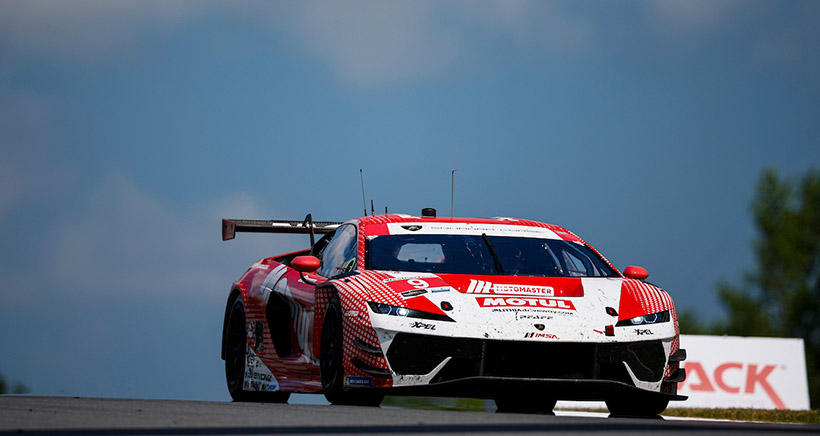
Behind Pfaff, the established GTD Pro names did not disappear – Paul Miller Racing, Corvette Racing by Pratt Miller, Heart of Racing – but the headlines went to the orange car that executed the brief best on the day. In a class that already has a tight teams’ championship fight, Road America’s result adds another layer: the Lamborghini package has proved it can win in a long‑distance IMSA environment, and Pfaff has reminded everyone that it doesn’t need the comfort of a long‑term manufacturer alignment to deliver results at the front.
GTD – Winward keeps its roll going
If LMP2 has Inter Europol as its form team, then GTD has Winward Racing. At Road America, the No. 57 Mercedes‑AMG GT3 driven by Russell Ward, Philip Ellis and Indy Dontje took its second consecutive class win, underlining just how dialled‑in the programme has become as the season reaches its endurance peak. In a field of 19 GTD entries, managing the race is half the battle; Winward managed both the race and the risk.
Their performance wasn’t built on runaway pace. Across six hours, the No. 57 consistently sat within the lead group, rarely dropping into the midfield but also rarely taking unnecessary risks in traffic when GTPs and LMP2s were storming through. Strategy was conservative where it needed to be, opportunistic where the timing was right – a blend that allowed them to capitalise when rivals tripped over slower GTD cars or mistimed their full‑course‑yellow stops.
The win carries obvious championship implications. With Heart of Racing already a benchmark in the GTD standings, Winward’s back‑to‑back victories raise the prospect of a multi‑team fight that will run all the way to Petit Le Mans. For IMSA as a whole, it reinforces how valuable the GTD class has become: it is no longer just a stepping stone or a pro‑am sidebar; at Road America, the GTD race provided as much narrative detail – intra‑team battles, tyre calls, traffic risks – as any of the pro classes