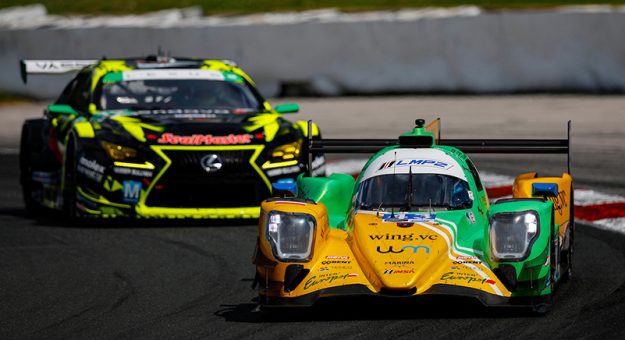
From the outside, the Chevrolet Grand Prix at Canadian Tire Motorsport Park will sit neatly in the 2026 results book: Tom Dillmann and Jeremy Clarke, pole to victory in the No. 43 Inter Europol Competition ORECA, first LMP2 win of the year ticked off in the Bowmanville hills. On a weekend where prototypes and GT cars share the same narrow strip of fast Canadian asphalt, it reads like a straightforward success. In real time, it felt more like a tightrope act on vapour.
Canadian Tire Motorsport Park is one of those circuits that compresses modern sports car racing into a very old‑school frame. The corners come in long, leant‑on arcs; the run‑offs are suggestive rather than expansive. You do not so much “manage” traffic here as coexist with it, particularly in the closing minutes of a two‑hour, 40‑minute race when strategy, fuel and attention spans all reach their limits.
On Sunday, LMP2 was the class that carried the main narrative. The secondary prototypes headlined the race, and for much of the afternoon it looked like the No. 43 crew had everything under control. Dillmann and Clarke led from the front, managed the pace, and stayed out of the inevitable skirmishes in traffic. The twist came, as it often does now, on the pit lane.
Late in the race, with just north of 50 minutes remaining, teams found themselves facing the same uncomfortable question: run aggressively and accept the need for a late splash, or short‑fill now and pray for a yellow that never came. The second half of the race ran green for longer than comfort would normally allow, and the fuel windows began to pinch.
In the end, it came down to execution—not on the track, where traffic and racecraft had been constant, but in the precision of a stopwatch on pit lane. Inter Europol’s final visit to the pits was a study in economy: a 34.269‑second stop, barely more than a pause, enough to take on the necessary splash and nothing more. CrowdStrike Racing by APR, their closest rivals, needed 35.470 seconds for their equivalent service. That 1.2‑second difference in the alley translated into clean track for Dillmann when it mattered most.
From there, the Frenchman kept the gap elastic but intact. Alex Quinn, in the No. 04 CrowdStrike car, pressed as hard as traffic and fuel would allow, but the race had already been tilted by that marginal gain on the lane. At the flag, the No. 43’s advantage was 9.796 seconds, a margin that looked comfortable on paper but was built on a run of tiny, precise decisions made under pressure. AO Racing’s No. 99 ORECA, driven by Dane Cameron and PJ Hyett, completed the podium, rounding out a LMP2 result sheet that read like a reward for those who had managed both speed and arithmetic.
Further down the order, the story was more bruising. None of the Bronze‑rated Canadian drivers who might have hoped to mark their home race with a podium could quite get there in LMP2. Pfaff Motorsports and 13 Autosport—standard bearers in the GT classes—found the afternoon heavy going, their results more reflective of how unforgiving CTMP can be than of any lack of ambition.
If LMP2’s race was defined by a single decisive splash, the GT classes were shaped by a slightly different kind of calculation.
 The Lexus that short‑filled its way to the front
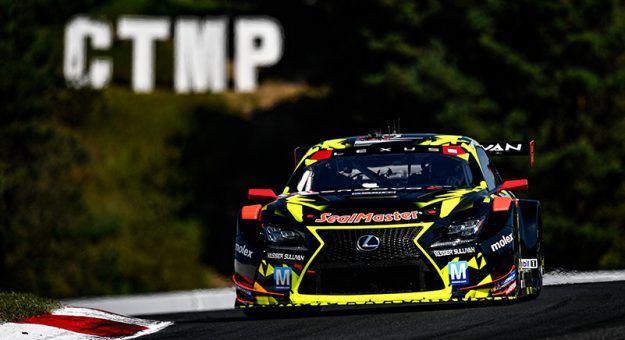 The Lexus that short‑filled its way to the front
In GTD PRO, Vasser Sullivan Racing’s No. 14 Lexus RC F GT3, with Jack Hawksworth and Ben Barnicoat on driving duty, left Bowmanville with a second straight class win and the sense of a plan finally clicking into place. They arrived in Canada off the back of victory at the Sahlen’s Six Hours of The Glen; they left with another trophy and a story centred not on outright pace, but on the way they choreographed the first stop
The critical moment came 42 minutes into the race. The yellow and black Lexus peeled off for its first service, Hawksworth handing over to Barnicoat. The team took only what they needed: a short fill rather than a full tank, stopping the clock at 46.179 seconds in pit lane. On a circuit where track position is more than just a convenient metric—where passing a similarly matched GT3 car can quickly become an exercise in risk management—that half‑measure of fuel was the full measure of their intent.
Once back on track, the race pivoted from calculation to commitment. Barnicoat climbed back through the order, found his way to second, then lined up the move that would define the afternoon: a pass on Nikita Johnson’s RLL‑run McLaren 720S GT3 EVO, the No. 59 car that had been setting the tone at the front. When the Lexus went by, the dynamic shifted. Over the remaining 118 laps, Barnicoat and Hawksworth’s car led 78 of them, converting pit lane efficiency into authority on the road, and closing out the win by 1.993 seconds.
Hawksworth was clear afterwards where he thought the credit lay. It was, as he described it, “a really impressive day from the team”: a clean start, a perfectly judged first pit cycle, and a strategist and crew who made the numbers work. He highlighted Barnicoat’s overtake on the McLaren and pointed back, with the easy shorthand of a long working relationship, to engineer Geoff Fickling, who has been with him since those early open‑wheel tests at Indianapolis in 2011.
There was also a sense of relief mixed with pride. The pair joked that their luck at Canadian Tire Motorsport Park had never been particularly kind when starting from the front; starting sixth in GTD PRO this time, then climbing to the win, felt like a quiet correction. It was, as Hawksworth put it, a “well‑executed race”—flawless strategy, clean stops, and a team finally seeing its work reflected in the standings.
The result carried an extra layer of significance for Lexus. It marked the 20th win for the RC F GT3 platform, 18 of those now delivered by Vasser Sullivan, and made CTMP the ninth different IMSA circuit where the programme has taken a victory. In a field that has grown only more competitive as GT3 regulations have matured, that kind of geographical spread matters
Behind the Lexus, AO Racing used their own blend of pace and timing to return to the GTD PRO podium for the first time since WeatherTech Raceway Laguna Seca, with Nick Tandy and Harry King guiding the No. 77 Porsche 911 GT3 R (992) to second. The Paul Miller Racing BMW, the No. 1 M4 GT3 EVO started and finished by Neil Verhagen and shared with Connor De Phillippi, took third, its afternoon coloured by a mid‑race “hip check” from an LMP2 car on the exit of Turn 1. Even with that delay, the car recorded its third podium and fifth top‑five in six races
That consistency has consequences. Unofficially, the Paul Miller BMW left Canada 108 points clear of the No. 4 Corvette Racing by Pratt Miller Motorsports Z06 GT3.R, which finished fourth with Nicky Catsburg and Tommy Milner at the wheel. Just 60 points separate second through sixth in the GTD PRO standings, and the No. 14 Lexus pairing now sits fourth, 150 points off the lead—a gap Hawksworth seems intent on closing by ignoring it. “After some tough races, we’re just going for wins,” he said. “If we keep doing that, the points will take care of themselves.”
GTD: a restart, and a Mercedes that made it stick
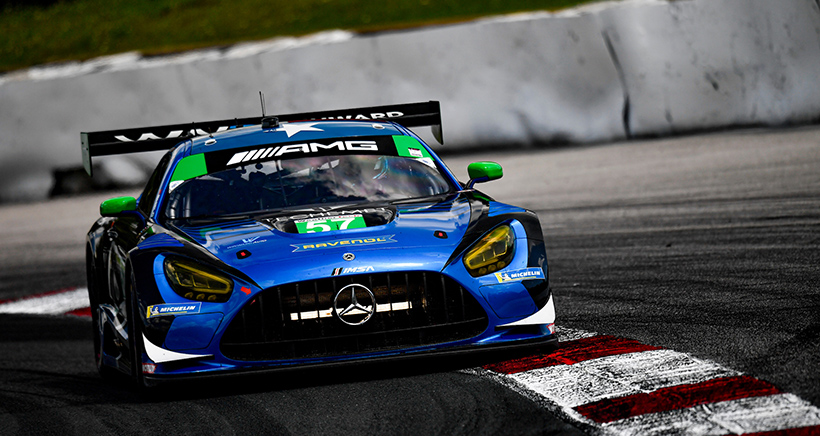 GTD: a restart, and a Mercedes that made it stick
In the pro‑am GTD field, the narrative felt similar in shape but different in detail. Winward Racing returned to the top of the class for the second time this year—adding the Chevrolet Grand Prix to their Rolex 24 At Daytona victory—thanks to a blend of precise stops and one particularly assertive restart from Philip Ellis.
The No. 57 Mercedes‑AMG GT3, started by Russell Ward, spent the early part of the race hovering in the midfield, starting fourth and running fifth through the opening stint. Slick work from the crew moved the car up to second during the first round of pit stops, shifting the pressure onto Ellis when he climbed aboard
The defining moment came not in the calm of a pit window, but in the chaos that followed the second and final restart, with one hour and 47 minutes still on the clock. Ahead of Ellis, Trent Hindman controlled the class in another Mercedes. Behind, the pack shuffled and jostled, each driver trying to find space where there was none. Ellis described what happened next in the matter‑of‑fact way only drivers can when talking about something that required both nerve and judgement.
“It’s just one of those optimistic restarts,” he said, likening it to a move he had pulled off at Road America the previous year. “Everybody is so tossed up and fighting each other and not really watching the mirrors, and it just opens the room for me to go through.” The move worked because he trusted that “everybody paid enough attention not to bang wheels”. Once through, he controlled the gap, bringing the No. 57 home 1.886 seconds clear of the field.
Behind him, Aaron Telitz and Benjamin Pedersen secured second in the No. 12 Vasser Sullivan Lexus RC F GT3, reinforcing the breadth of that team’s weekend across both GTD and GTD PRO. Turner Motorsport’s Robby Foley and Patrick Gallagher took third in the No. 96 BMW M4 GT3 EVO, adding more weight to their own championship campaign.
Championship leader Eduardo “Dudu” Barrichello had a more complicated day. A penalty on the No. 27 Heart of Racing Aston Martin Vantage GT3 Evo at the first stop forced co‑driver Roman De Angelis into a damage‑limitation run, climbing back to sixth by the flag. The net effect was to compress the points picture without entirely rewriting it: Barrichello still leads, now 92 points clear of Telitz and Pedersen, with Foley and Gallagher 120 back in third. Ellis and Ward, who had seen a rough run of races erode their early momentum, used the win to pull themselves back into the conversation, now fourth and 207 points in arrears.